

Software as a Medical Device Market to reach USD 80.12 Billion by 2035 at 34.5% CAGR
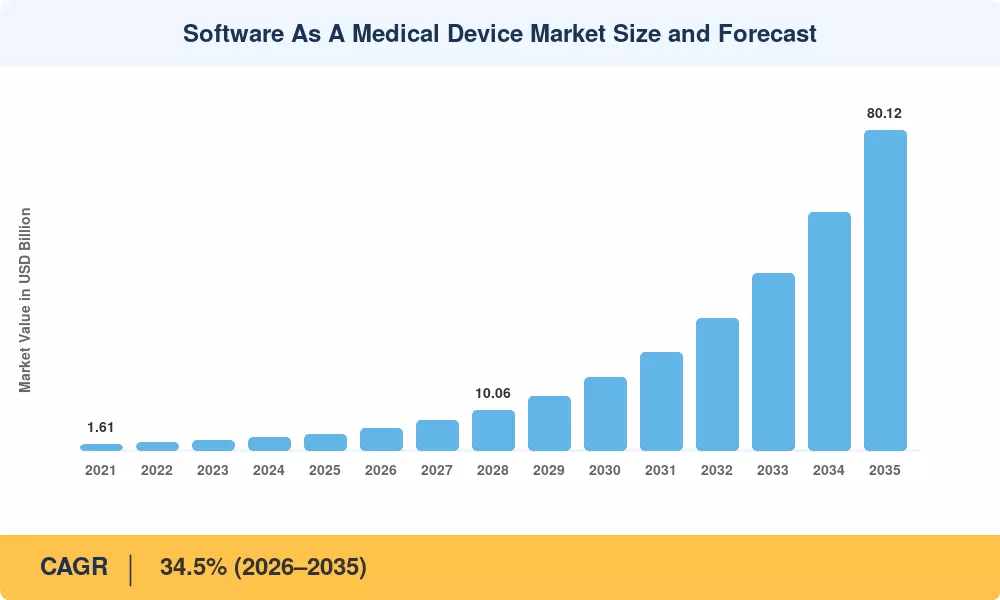
Software As A Medical Device Market Size
Software as a Medical Device Market to Surge from $5.56B in 2026 to $80.12B by 2035-By FDA Predetermined Change-Control Plan, Payer Reimbursement Code Expansion
NY, CA, UNITED STATES, June 26, 2026 /EINPresswire.com/ -- As per Market Research Future, the global Software as a Medical Device Market size to reach USD 80.12 Billion by 2035 from USD 5.56 Billion in 2026, at a CAGR of 34.5% during the forecast period 2026--2035. The market base was estimated at USD 4.08 Billion in 2025.The 34.5% CAGR---anchored by regulatory streamlining and payer reimbursement adoption rather than discretionary healthcare spending---is driven by three converging forces: the FDA's predetermined change-control plan framework, which lets manufacturers update AI-driven algorithms without full resubmission and has brought the average time-to-update down from 14 months to less than 90 days; a wave of new CPT reimbursement codes that finally give health systems a revenue pathway for prescribing standalone software, converting what was previously a hospital IT cost center into a billable clinical service; and the maturation of cloud-native and edge-AI architectures that enable training in the cloud and inference at the point of care, consistent with data-sovereignty rules in the EU and Southeast Asia.
Request A Free Sample:
https://www.marketresearchfuture.com/sample_request/11602
Key Market Trends & Growth Drivers
Regulatory Streamlining for Adaptive Algorithms and FDA Predetermined Change-Control Plans
The FDA's 2023 guidance permits manufacturers to establish an "algorithm change protocol" at initial approval for predefined change-control plans, so that a new 510(k) is not needed every time a model is retrained. By early 2025, more than 40 authorized marketing applications referenced this method, bringing the average time-to-update down from 14 months to less than 90 days.
The EU's Medical Device Regulation (MDR) has added similar requirements in its Annex XIV clinical-evaluation revisions, creating a transatlantic corridor that favors global SaMD vendors. The IMDRF's working group on SaMD has published three foundational guidance documents, and convergence between the FDA, EU MDR, PMDA, and NMPA frameworks is accelerating. By 2035, a single clinical-evidence package may satisfy two or three major jurisdictions simultaneously, reducing the global go-to-market timeline from 36+ months to under 18 months. This regulatory shift transforms sporadic pilot deployments into steady multi-year enterprise contracts.
Payer Adoption of Reimbursement Codes and Value-Based Care Alignment
CMS activated three new Category I CPT codes for autonomous AI diagnostic interpretations in January 2025, covering diabetic retinopathy screening, cardiac ejection-fraction estimation, and stroke-triage notification. Private insurers followed. This shift converts what was previously a hospital IT cost center into a billable clinical service, unlocking institutional budgets that previously sat on the sidelines. Germany's DiGA framework has already approved reimbursement for several mental-health applications, creating a template that France, Belgium, and the Czech Republic are adapting.
The UK's NICE evidence standards for digital health and France's PECAN early-access scheme further expand the reimbursement footprint. Procurement teams now measure ROI through reduced time-to-diagnosis, downstream imaging-volume displacement, and avoidable hospital readmissions, with most systems requiring a break-even within 18 months of deployment.
Cloud-Native and Edge-AI Architecture Maturation and Wearable Device Proliferation
In 2024, health-cloud sales on AWS, Azure, and GCP crossed USD 18 Billion, with specialized HIPAA- and MDR-compliant compute tiers being the norm. Meanwhile, Qualcomm and Apple have introduced edge inference chips that can run lightweight diagnostic models locally on smartphones and wearables. The combination provides a hybrid deployment approach with training done in the cloud and inference done at the point of care, a model consistent with data-sovereignty rules in the EU and Southeast Asia.
Global smartwatch and health-tracker shipments exceeded 230 million units in 2024, and an increasing share carry sensors capable of clinical-grade photoplethysmography, single-lead ECG, and continuous glucose estimation. Each sensor layer creates new data streams that SaMD platforms can ingest, turning consumer hardware into a distributed diagnostic network. Products with native FHIR-based EHR integrations see roughly 2.5× faster enterprise rollout, making interoperability a critical competitive differentiator.
Ask for Customization:
https://www.marketresearchfuture.com/ask_for_customize/11602
Market Segment Insights
BY DEPLOYMENT TYPE
Cloud-Based: Dominant segment with 68.2% revenue share in 2025. Reflecting health-system preference for scalable, vendor-managed infrastructure that aligns with broader IT migration strategies and eliminates the need for on-site GPU clusters. Major cloud providers now offer pre-certified HIPAA and MDR-compliant compute environments, reducing the compliance burden for SaMD developers. Per-study and per-patient-per-month subscription models are overtaking perpetual licenses, lowering adoption barriers for smaller facilities and aligning vendor revenue with clinical throughput.
On-Premises: Retains relevance in high-security environments such as defense medical facilities and regions with strict data-residency laws, though share is contracting year over year as hybrid architectures gain traction.
BY APPLICATION
Screening and Early Detection: Dominant application with 42.1% revenue share in 2025. Led by radiology triage and dermatology classification platforms deployed in emergency departments and outpatient imaging centers. AI-assisted radiology and pathology triage tools have become the default entry point for health systems adopting SaMD, driven by measurable reductions in time-to-diagnosis and downstream imaging-volume displacement.
Chronic Condition Management: Fastest-growing application segment at 36.8% CAGR (2026--2035). Supported by remote patient monitoring integration and the global shift toward value-based care models that reward long-term outcome management over episodic treatment. Wearable-SaMD convergence is creating continuous monitoring ecosystems for diabetes, cardiovascular disease, and respiratory conditions.
BY END USER
Hospitals and Clinics: Largest segment at 43.9% share in 2025. Anchored by enterprise-wide platform licensing deals that serve multiple departments. Enterprise procurement cycles favor platform-scale deployments with native FHIR-based EHR integrations, which see roughly 2.5× faster rollout than standalone point solutions.
Home-Care Settings: Fastest-growing end-user segment at 38.7% CAGR (2026--2035). As consumer wearables embed clinical-grade inference capabilities and payers incentivize hospital-at-home programs. The convergence of consumer hardware and regulated software is creating a distributed diagnostic network that extends the Software as a Medical Device Market beyond traditional clinical settings.
BY DEVICE TYPE
Mobile Devices: Dominant device category, driven by smartphone-based diagnostic applications and telemedicine platforms. The ubiquity of smartphones in both developed and emerging markets makes mobile the default deployment target for Category I and II SaMD products.
Wearable Devices: Fastest-growing device category, propelled by clinical-grade sensor integration in smartwatches and health trackers. Global shipments exceeded 230 million units in 2024, with an increasing share carrying sensors capable of clinical-grade photoplethysmography, single-lead ECG, and continuous glucose estimation.
Read Detailed Insights:
https://www.marketresearchfuture.com/reports/software-as-a-medical-device-market-11602
Regional Outlook
North America --- Dominant Market (~38.4% Share, 2025)
The United States generates approximately 82.5% of North American Software as a Medical Device Market revenue, driven by CMS reimbursement codes, a deep VC ecosystem, and mature regulatory infrastructure. The FDA's Digital Health Center of Excellence has streamlined 510(k) and De Novo pathways for AI-enabled devices, while CMS activation of Category I CPT codes in January 2025 created a direct revenue pathway for autonomous AI diagnostic interpretations.
Canada contributes through Health Canada's digital-health framework at approximately 10.8% of regional share. Mexico is growing at approximately 36.2% CAGR on IMSS telemedicine expansion, with AI-assisted imaging triage being piloted across 14 state hospitals. North America's leadership rests on reimbursement depth and the structural enterprise licensing segment created by EHR-integrated platform deployments.
Europe --- Fastest-Growing Region (39.7% CAGR, 2026--2035)
Europe's growth in the Software as a Medical Device Market is underpinned by the EU AI Act's risk-tiered classification, which provides manufacturers with a predictable conformity pathway. Germany leads regionally with BfArM's DiGA reimbursement pathway, contributing approximately 24.6% of regional revenue---over 65 DiGA applications processed since 2020. The United Kingdom contributes approximately 21.3% of regional share through NICE evidence standards for digital health and the MHRA's Innovative Devices Access Pathway, accelerating clearances by roughly 30% versus standard CE-marking timelines.
Asia-Pacific --- Second Largest (~22.3% Share, 2025)
Asia-Pacific holds the second-largest share of the Software as a Medical Device Market. China contributes approximately 33.5% of regional revenue through NMPA's AI regulatory sandbox in Hainan Province, allowing foreign SaMD companies to test products under supervised real-world conditions. India is growing at approximately 37.4% CAGR on Ayushman Bharat digital mandates---the Mission has budgeted INR 1,600 crore (about USD 190 million) by 2027 for digital-health infrastructure.
Japan contributes approximately 22.1% of regional share through PMDA's dedicated SaMD approval track introduced in 2023, cutting median review time to 7 months. South Korea holds approximately 14.8% of regional share through MFDS AI-device approval pathway. ASEAN economies are growing at approximately 31.9% CAGR on mobile-health leapfrogging, bypassing legacy infrastructure to deploy cloud-native diagnostic platforms directly. The region's combined telemedicine mandates and mobile-first deployment strategies anchor the global volume base for SaMD adoption.
Middle East & Africa --- Emerging Opportunity (USD 0.22 Billion, 2025)
The Middle East & Africa carries significant specialist access gaps and therefore opportunity. Saudi Arabia leads the region with Vision 2030 health-sector digitization, contributing approximately 31.7% of regional share---over USD 3.2 Billion earmarked for health-sector digitization. The UAE contributes approximately 28.9% of regional share through Dubai Health Authority AI strategy, including an AI-powered diagnostic center launched in 2024. South Africa contributes approximately 18.4% of regional share on NHI system modernization.
Egypt is growing at approximately 37.6% CAGR on population health-screening mandates. The rest of MEA is growing on NGO-led digital-health deployments at approximately 12.8% of regional share. Gulf Cooperation Council states are investing heavily in healthcare AI infrastructure as part of economic diversification agendas, creating new greenfield demand for cloud-native diagnostic platforms across the Software as a Medical Device Market.
Competitive Landscape and Recent Developments
The Software as a Medical Device Market exhibits medium concentration, with the top five players accounting for an estimated 32--38% of global revenue, while a long tail of over 300 specialized algorithm developers fragments the remaining share. Market entry barriers are rising as regulatory requirements tighten, but the asset-light nature of software development keeps the pipeline of challengers active. Strategic acquisitions accelerated in 2024, with large medtech and health-IT incumbents absorbing clinical-AI startups to fill portfolio gaps. Concentration is highest in high-income segments where regulatory and clinical-validation barriers are steep; the emerging-market tier is more fragmented as regional developers compete on price and localization.
The competitive landscape is stratified between integrated imaging-SaMD workflow leaders serving hospital enterprise contracts, specialized point-solution providers capturing niche diagnostic applications, and platform-as-a-service vendors offering white-label algorithm layers to health-IT incumbents.
KEY COMPANIES AND RECENT MILESTONES
Siemens Healthineers (December 2020): Formally deployed its advanced AI-Pathway Companion clinical decision support platform, correlating imaging, laboratory diagnostics, and clinical history files to optimize pre-therapeutic prostate cancer multi-disciplinary care workflows. Estimated revenue share: approximately 7--10%. Integrated imaging-SaMD workflow leader.
GE HealthCare (June 2024): Completed the integration of Caption Health's cardiac ultrasound AI into the Venue Go platform, enabling autonomous ejection-fraction assessment at the point of care. Estimated revenue share: approximately 6--9%. Ultrasound AI and cardiology focus.
Philips Healthcare (2024--2025): HealthSuite and Illumeo platforms anchor enterprise imaging analytics positioning. Estimated revenue share: approximately 5--8%.
Medtronic (2024--2025): GI Genius endoscopy AI and Sugar.IQ diabetes management anchor therapeutic SaMD positioning. Estimated revenue share: approximately 4--7%.
Future Outlook: 2026--2035
By 2030, autonomous clinical decision loops will become the operating system of acute care delivery. A growing share of SaMD products will operate in semi-autonomous modes---issuing clinical decisions that proceed to action unless a physician overrides them. The vendors that build robust audit trails and explainability layers will secure first-mover advantage in high-acuity specialties like stroke and STEMI triage. Category II products inform clinical decisions but do not act autonomously, while Category III tools can drive urgent interventions without prior physician review. The distinction shapes both validation evidence requirements and liability allocation, creating tiered competitive moats within the Software as a Medical Device Market.
More Related Research Insights:
https://www.marketresearchfuture.com/reports/digital-healthcare-market-7636
https://www.marketresearchfuture.com/reports/healthcare-it-market-5950
https://www.marketresearchfuture.com/reports/clinical-decision-support-systems-market-6038
https://www.marketresearchfuture.com/reports/healthcare-artificial-intelligence-market-5681
https://www.marketresearchfuture.com/reports/telemedicine-market-2216
https://www.marketresearchfuture.com/reports/remote-patient-monitoring-market-10905
https://www.marketresearchfuture.com/reports/medical-imaging-software-market-7622
https://www.marketresearchfuture.com/reports/healthcare-analytics-market-7819
https://www.marketresearchfuture.com/reports/wearable-medical-device-market-899
Larry Wilson
WantStats Research And Media Pvt. Ltd.
+1 855-661-4441
email us here
Visit us on social media:
LinkedIn
Facebook
YouTube
X
Legal Disclaimer:
EIN Presswire provides this news content "as is" without warranty of any kind. We do not accept any responsibility or liability for the accuracy, content, images, videos, licenses, completeness, legality, or reliability of the information contained in this article. If you have any complaints or copyright issues related to this article, kindly contact the author above.
