

Global Clean Beauty Market Estimated to Grow at 14.62% CAGR Due to Demand for Natural Skincare Solutions
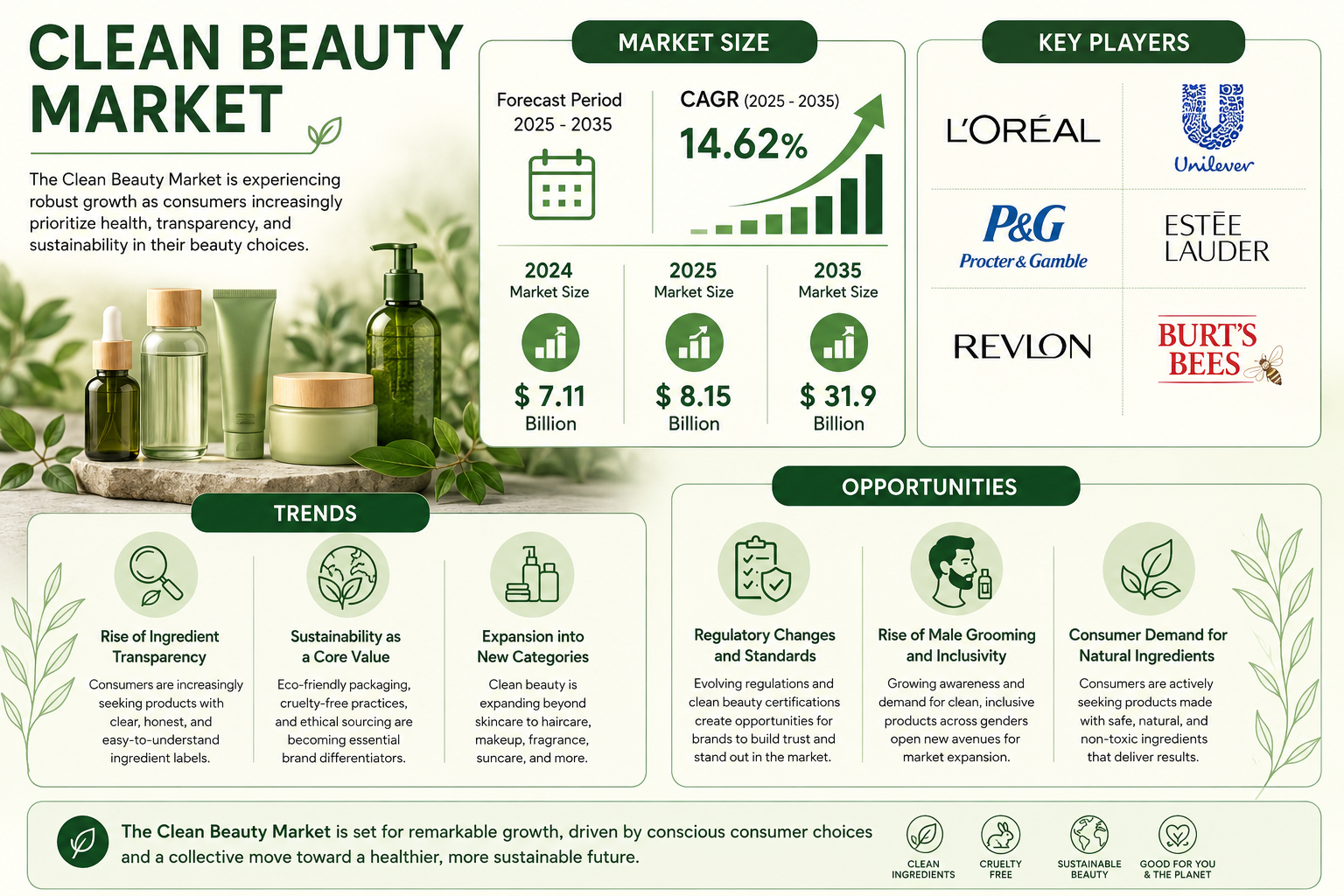
Clean Beauty Market
Clean Beauty Market is currently experiencing a notable transformation, driven by a growing consumer awareness regarding the ingredients used in personal care.
NEW YORK, NY, UNITED STATES, June 29, 2026 /EINPresswire.com/ -- The global Clean Beauty Market is witnessing remarkable growth as consumers increasingly prioritize product safety, sustainability, and ingredient transparency in their personal care routines. According to recent industry analysis, the market was valued at USD 7.11 billion in 2024 and is projected to grow to USD 8.15 billion in 2025. By 2035, the industry is expected to reach an impressive USD 31.9 billion, registering a robust compound annual growth rate (CAGR) of 14.62% during the forecast period from 2025 to 2035.The rapid expansion of the clean beauty sector highlights a major transformation in consumer preferences, with individuals increasingly seeking products formulated with naturally derived ingredients, ethical sourcing practices, and environmentally friendly packaging solutions. The market is also benefiting from heightened awareness regarding the potential health effects of synthetic chemicals and the increasing popularity of sustainable lifestyles.
Market Overview:
The clean beauty industry has evolved from a niche segment into one of the fastest-growing categories within the global cosmetics and personal care sector. Consumers are becoming more conscious about the ingredients present in skincare, haircare, makeup, and personal hygiene products. As a result, demand for products that are free from parabens, sulfates, phthalates, synthetic fragrances, and other controversial chemicals has surged significantly.
In recent years, transparency has become a defining feature of beauty purchasing decisions. Consumers now expect brands to disclose ingredient sourcing, manufacturing practices, and environmental impact. This shift has encouraged manufacturers to reformulate products and invest heavily in cleaner, safer alternatives.
The increasing influence of social media, beauty influencers, and digital awareness campaigns has further accelerated market adoption. Consumers are now better informed about ingredient safety and sustainability, leading to substantial changes in purchasing behavior across global markets.
Market Size and Forecast Analysis:
The Clean Beauty Market is poised for exceptional growth over the next decade. The industry is expected to nearly quadruple in size between 2025 and 2035, demonstrating strong consumer demand and favorable market fundamentals.
The growth trajectory is supported by increasing disposable incomes, rising spending on premium personal care products, and growing acceptance of clean beauty products among mainstream consumers. Emerging economies are also becoming important contributors to market expansion, as awareness regarding health-conscious beauty solutions continues to rise.
Furthermore, the increasing availability of clean beauty products through both physical and online retail channels is helping brands reach a wider audience. Product innovation and premiumization trends are expected to create additional revenue opportunities throughout the forecast period.
Download Free Sample PDF Copy : – Access A Complimentary Copy of Our Report to Explore Its Content and Insights
https://www.marketresearchfuture.com/sample_request/11976
Key Market Drivers:
Growing Preference for Sustainable Ingredients
One of the most significant factors driving market growth is the increasing consumer demand for sustainable and naturally derived ingredients. Modern consumers are paying greater attention to product labels and actively seeking formulations that contain botanical extracts, plant-based oils, and naturally sourced active ingredients.
Consumers are also becoming increasingly aware of the environmental consequences of conventional cosmetic manufacturing. This has encouraged brands to adopt sustainable sourcing practices and environmentally responsible production methods.
Rising Health and Wellness Awareness
The global wellness movement has significantly influenced the beauty industry. Consumers increasingly associate beauty products with overall health and well-being, prompting them to choose products that are perceived as safer and less harmful to both the body and the environment.
The demand for toxin-free and dermatologist-tested products has risen substantially, especially among younger demographics and health-conscious consumers.
Increasing Demand for Transparency
Modern consumers expect complete transparency regarding product formulations and ingredient sourcing. Brands that provide clear labeling, ethical sourcing information, and sustainability certifications are gaining significant consumer trust and loyalty.
This emphasis on transparency has intensified competition and encouraged continuous innovation throughout the industry.
Emerging Market Trends:
Expansion of Vegan and Cruelty-Free Beauty Products
Vegan and cruelty-free cosmetics are becoming mainstream categories within the clean beauty market. Consumers increasingly prefer products that avoid animal-derived ingredients and support ethical manufacturing practices.
Many brands are obtaining cruelty-free certifications and investing in alternative ingredient technologies to meet growing consumer expectations.
Sustainable Packaging Innovations
Packaging sustainability has emerged as a critical purchasing consideration. Beauty companies are introducing recyclable materials, refillable containers, biodegradable packaging solutions, and reduced plastic usage initiatives.
Sustainable packaging not only addresses environmental concerns but also strengthens brand identity among environmentally conscious consumers.
Rise of Personalized Clean Beauty Solutions
Technological advancements and artificial intelligence are enabling brands to offer customized skincare and beauty solutions based on individual skin types, concerns, and preferences.
Personalized product recommendations and tailored formulations are expected to become increasingly important competitive differentiators in the coming years.
Growth of Digital and Direct-to-Consumer Channels
Digital platforms have significantly transformed the clean beauty landscape. Social commerce, influencer marketing, and direct-to-consumer business models are enabling brands to build stronger relationships with consumers while expanding their global reach.
Online channels also provide consumers with easier access to ingredient information and product reviews, further supporting market growth.
Market Segmentation:
By Product Type:
The Clean Beauty Market is segmented into skincare products, haircare products, makeup products, fragrances, and personal care products. Among these categories, skincare products hold a dominant position owing to increasing consumer demand for natural cleansers, moisturizers, serums, and anti-aging solutions formulated without harsh chemicals. Haircare and makeup segments are also witnessing substantial growth as consumers increasingly seek products made with plant-based and non-toxic ingredients.
By Form:
Based on form, the market includes creams, lotions, gels, powders, liquids, and other formulations. Creams and lotions continue to account for a significant share due to their widespread use in skincare and personal care applications. Meanwhile, gels and liquid formulations are gaining popularity because of their lightweight texture, ease of application, and multifunctional properties. Continuous product innovation is encouraging manufacturers to introduce advanced formulations that cater to diverse consumer preferences.
By Consumer Group:
The market caters to various consumer groups, including Millennials, Generation Z, Generation X, and Boomers. Millennials and Generation Z represent the largest consumer base, driven by their strong inclination toward sustainability, ethical consumption, and ingredient transparency. However, Generation X and Baby Boomers are increasingly embracing clean beauty products, particularly in the premium skincare and anti-aging segments.
By End User:
On the basis of end user, the market is divided into men and women. Women continue to generate the majority of market demand due to their higher spending on skincare and cosmetic products. However, the men's segment is expanding rapidly as awareness regarding personal grooming, skincare routines, and wellness-focused beauty products continues to rise globally.
By Distribution Channel:
The market is distributed through supermarkets and hypermarkets, specialty stores, pharmacies, online retail platforms, and other channels. Online retail has emerged as the fastest-growing segment due to the convenience of shopping, access to a wider product range, and increasing consumer engagement through digital platforms and social media. Specialty stores and pharmacies also remain important distribution channels, particularly for premium and dermatologist-recommended clean beauty products.
Competitive Landscape and Key Players:
The global Clean Beauty Market is highly competitive and characterized by the presence of both established multinational beauty companies and emerging niche brands. Competition is primarily centered on product innovation, sustainable sourcing, ingredient transparency, and environmentally responsible packaging solutions.
Leading companies are investing significantly in research and development to formulate products that align with evolving consumer preferences for natural, safe, and ethically produced beauty products. Digital transformation has also become a key competitive strategy, with brands strengthening their e-commerce capabilities and direct-to-consumer channels to improve customer engagement and expand their global reach.
Leading companies operating in the market include:
▪️L'Oréal (France)
▪️Unilever (United Kingdom)
▪️Procter & Gamble (United States)
▪️Estée Lauder (United States)
▪️Revlon (United States)
▪️Burt's Bees (United States)
▪️Drunk Elephant (United States)
▪️Herbivore Botanicals (United States)
▪️Tatcha (United States)
These industry participants are focusing on expanding their clean beauty product portfolios, adopting sustainable packaging initiatives, and introducing innovative formulations featuring naturally derived ingredients. Strategic partnerships, mergers, and acquisitions are also becoming increasingly common as companies seek to strengthen their market presence and capitalize on the rapidly growing demand for clean beauty products worldwide.
Regional Outlook:
North America
North America remains one of the largest markets for clean beauty products, driven by high consumer awareness regarding ingredient safety and sustainability. The region benefits from strong demand for premium skincare products and the presence of major beauty companies.
Europe
Europe represents a significant market due to stringent cosmetic regulations and growing consumer preference for environmentally responsible products. Sustainable beauty trends and ethical purchasing habits continue to support market expansion across the region.
Asia-Pacific
Asia-Pacific is expected to witness the fastest growth during the forecast period. Rising disposable incomes, increasing urbanization, and growing awareness regarding clean and natural ingredients are fueling demand across countries in the region.
South America and Middle East & Africa
These regions are gradually emerging as attractive growth markets due to improving economic conditions, expanding beauty industries, and increasing adoption of natural and sustainable products.
Future Outlook:
The future of the Clean Beauty Market appears exceptionally promising. Consumers are expected to continue prioritizing ingredient transparency, sustainability, and ethical production practices when purchasing beauty products.
Technological innovation, personalized beauty solutions, and eco-friendly packaging developments are likely to create significant growth opportunities for industry participants over the next decade.
As consumer awareness continues to evolve and sustainability becomes increasingly important, clean beauty products are expected to transition from a premium niche category into a mainstream component of the global cosmetics industry.
Frequently Asked Questions (FAQs)?
1. What is driving the growth of the Clean Beauty Market?
The market is primarily driven by rising demand for natural ingredients, increasing awareness of product safety, and growing consumer preference for sustainable and ethically produced beauty products.
2. How large is the Clean Beauty Market expected to become by 2035?
The global Clean Beauty Market is projected to reach USD 31.9 billion by 2035, growing at a CAGR of 14.62% from 2025 to 2035.
3. Which region is expected to witness the fastest growth?
The Asia-Pacific region is anticipated to register the fastest growth due to increasing disposable incomes, urbanization, and rising awareness regarding clean and natural beauty products.
4. Who are the major companies operating in the Clean Beauty Market?
Key players include L'Oréal, Unilever, Procter & Gamble, Estée Lauder, Revlon, Burt's Bees, Drunk Elephant, Herbivore Botanicals, and Tatcha.
Read Our Related Research Report:
Beauty Oils Market:
https://www.marketresearchfuture.com/reports/beauty-oils-market-23329
K Beauty Product Market:
https://www.marketresearchfuture.com/reports/k-beauty-product-market-33664
Beauty And Wellness Market:
https://www.marketresearchfuture.com/reports/beauty-and-wellness-market-25599
Organic Beauty & Personal Care Ingredients Market:
https://www.marketresearchfuture.com/reports/organic-beauty-personal-care-ingredients-market-1293
Foam Based Beauty And Personal Care Products Market:
https://www.marketresearchfuture.com/reports/foam-based-beauty-and-personal-care-products-market-24199
Sagar Kadam
Market Research Future
+ +1 628-258-0071
email us here
Visit us on social media:
LinkedIn
Facebook
YouTube
X
Legal Disclaimer:
EIN Presswire provides this news content "as is" without warranty of any kind. We do not accept any responsibility or liability for the accuracy, content, images, videos, licenses, completeness, legality, or reliability of the information contained in this article. If you have any complaints or copyright issues related to this article, kindly contact the author above.
